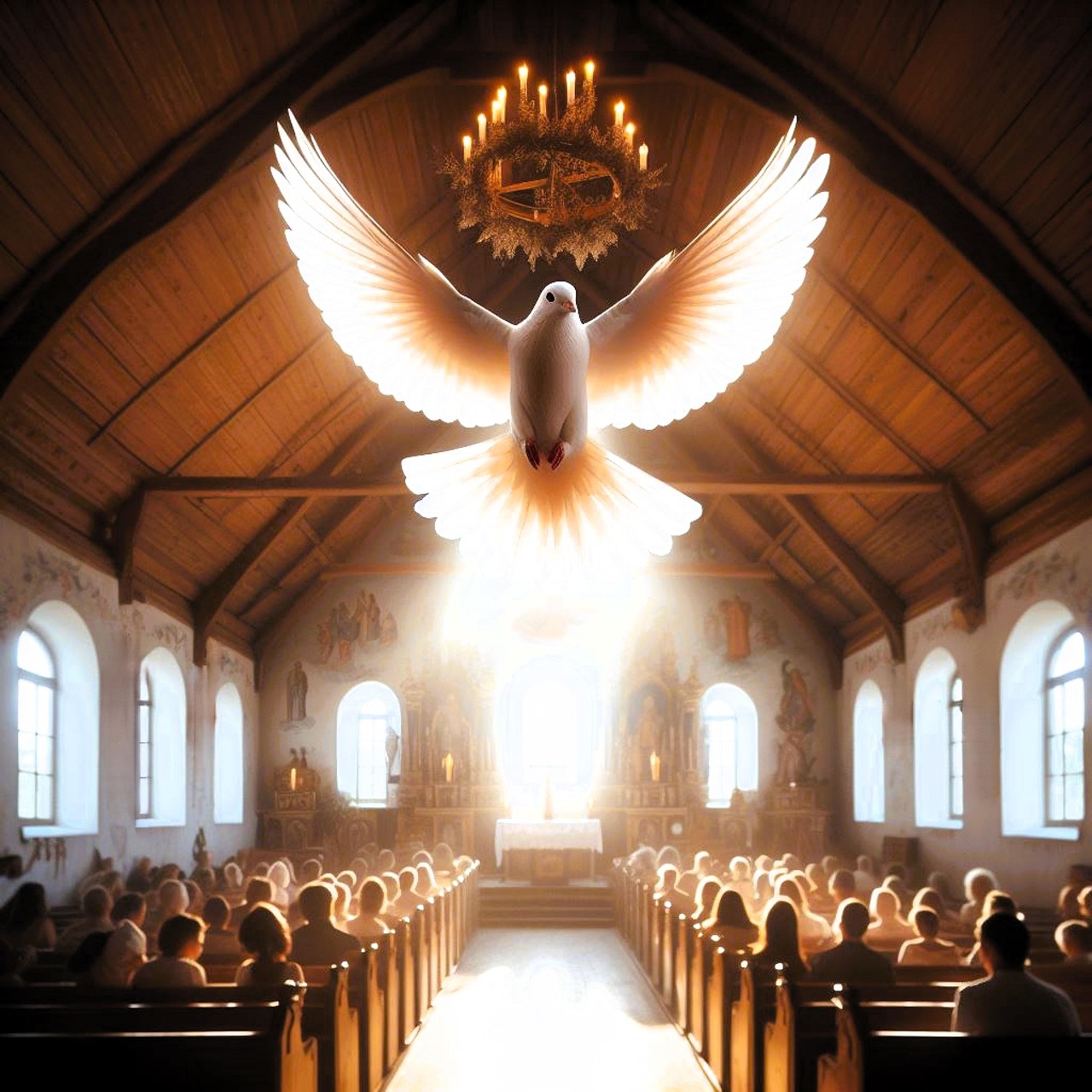
Reagan Cocke was a child during the charismatic renewal movement’s peak in the 1970s, and he recalls his parents leaving for a few weekends a year to travel across the country for ministry’s sake. Cocke’s mother and father served with Faith Alive, a ministry that dispatched lay ministers to local Episcopal churches for weekend-long spiritual renewal events.
These events, which thrived in the latter half of the 20th century, encouraged Christians in their faith through personal testimonies, keynote sessions, musical worship, shared meals, and healing prayer.
Touched by the Wind: The Charismatic Movement in the Episcopal Church
My mother met me at the door, her face bursting with excitement. “You will never guess what has happened,” she exclaimed. Before I could respond, she continued, “Pentecost has come to the Episcopalians!” The year was 1961. I was a senior in high school. Mother had just returned from a “prayer luncheon” at the local Episcopal Church where David duPlessis had brought word of Dennis Bennett’s “Pentecostal” experience at St. Mark’s in Van Nuys, California, the previous year. Later as I looked through the several issues of Trinity magazine, edited by Jean Stone a member of St. Mark’s, which mother had brought home with her, I, too, experienced the sense of excitement that God was about to do something new in His Church.
Almost forty years have passed since that incident. I have followed the developments of the Charismatic renewal within the Episcopal Church with great interest since then: for ten years from the perspective of a member of a Pentecostal denomination, and for the past thirty years as an Anglican. It is out of this dual background that I have been asked me to write a critical evaluation of the Charismatic Movement within the Episcopal Church.
The Church of the Redeemer, Charismatic Renewal, and Music in Anglican Worship
One reader’s comment in response to the article was that the Church of the Redeemer was responsible for the introduction of Pentecostal worship, guitars and drums, and praise choruses in the Episcopal Church. This comment was a rather inaccurate oversimplification of the role that Redeemer played in the changes in worship in the Anglican Church in and outside of North America and the changes that have occurred in Anglican worship.
The type of worship seen at Redeemer in the early 1970s exhibited a number of significant differences from the type of worship seen in Pentecostal churches in the same period. The ubiquitous electric guitar and drum kit of today’s bands comes not from the charismatic renewal movement of the 1960s - 1970s but the Praise and Worship movement of the late 1980s and early 1990s.
The Real Reasons Women are Done With Church
Christine Caine returns to the podcast to discuss the real reasons she thinks women are done with the church, how to get them back, why playing the Holy Spirit’s role in other people’s lives has to stop, and the necessity of being pruned if you want to flourish.
A Church Facilities Wish List
Our community at Church Answers Central recently discussed their wish list for their churches' facilities. Jess and Sam supplemented the list from our consultations. Here are the wishes in order of frequency.
The Five Reasons Church Building Projects Fail – How to Lead Yours to the Finish Line
Jess and Sam talk with Mike Stadelmayer at Church Growth Services. Church building projects carry tremendous ministry potential—but many stall, scale back, or never happen. The difference between success and frustration often comes down to the following critical factors....
Power Made Perfect in Weakness
This essay is part of a series on Ministry, Disabilities, and Inclusion running April 20-24. A Round Up with links will be available later this spring.
Why Christianity is public faith by design
Modern Christianity has embraced a contradiction. We insist that faith is deeply personal — yet fiercely resist allowing it to be public. We claim Jesus is Lord of all — yet confine Him to the private sphere. We preach transformation — yet recoil when that transformation disrupts public life. This version of Christianity feels polite. It feels safe. It is also foreign to Scripture. Christianity was never designed to be private.
Creating Margin in Ministry Through a Side Hustle and Travel Hacking, with Tim Walker (Ep 126)
“We also need to have an equal investment in rest and replenishment for the sake of longevity.”
When baptism becomes a carnival
In some evangelical circles, baptism is a spectator sport.
It’s always about which pastor or church can baptize the most people or put on the most extravagant baptismal super event.
The Four Causes of Spiritual Formation
Spiritual formation has become a hot topic in Christian theology. Over the past half-century, a cottage industry in evangelicalism has emerged around practices, habits, and intentional patterns of discipleship—often traced, symbolically, to the publication of Richard Foster’s Celebration of Discipline in 1978. This renewed interest is frequently driven by dissatisfaction with “thin” accounts of the Christian life that reduce discipleship either to doctrinal assent or to episodic moral effort. In response, many have emphasized holistic habits, intentional practices, and even personal “rules of life” as means of apprenticing to Jesus and inhabiting the kingdom in the present.
While this renewed attention is a welcome corrective to “thin” discipleship, it has also generated a certain conceptual fog. Many contemporary models of formation appear more like psychological self-help or therapeutic habit-stacking than distinctively Christian sanctification. And some worry, not without reason, that this new passion for “thick” discipleship defined by ascetical practices can cultivate spiritual pride rather than Christ-reliant Christlikeness. To clear this fog, we need a precise grammar that can name what is being formed, into what pattern, by what agency, and for what purpose. For this, we can turn to a classic analytical tool: Aristotle’s Four Causes. This will help us clarify just exactly what Christian spiritual formation is.

No comments:
Post a Comment