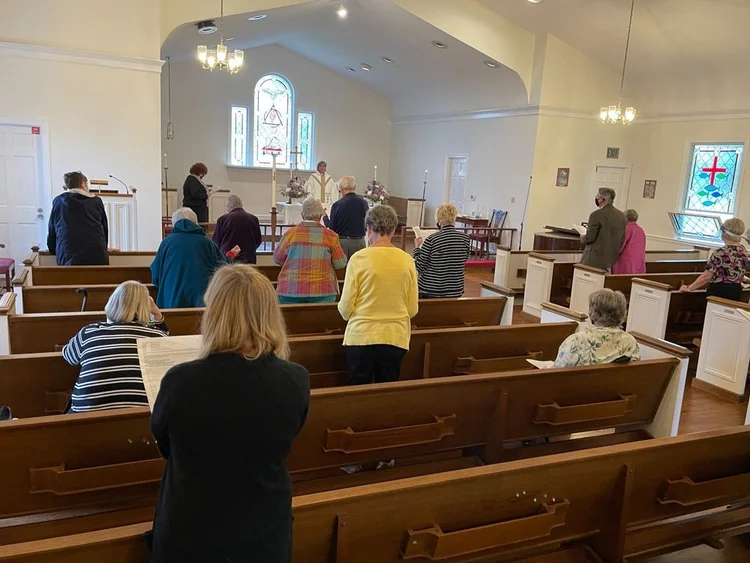
“The religious landscape of the United States has never looked starker than it does today. There are huge geographical swaths of America where the only place a Protestant can worship on a Sunday morning is an Evangelical church that takes a literalist view of the Bible and believes that women have no role in spiritual leadership....”
“The vibrant religious marketplace that was pervasive for most of U.S. history has been replaced by a type of faith that certainly appeals to a subset of the country but is objectionable, if not downright repulsive, to a significant number of Americans....”
“In short, American religion has become an ‘all or none’ proposition — conservative Evangelical religion or none at all. This leaves tens of millions of theological and political moderates with no place to find community and spiritual edification, or to work collectively to solve societal problems.”
Church Attendance Increases for the First Time in Decades
In 2025, the median congregation welcomed 70 attendees, up from 65 before the pandemic, according to the Hartford Institute for Religion Research.
Also See: Median worship attendance highest since COVID lockdowns: reportAttending multiple places of worship is the norm for many Americans
Surveys about religion often ask a single question about how often people go to services. That means researchers miss an important piece of the puzzle.
The Supreme Court gutted the Voting Rights Act. Black churches know exactly what to do.
We have been here before, and each time the Black church did not simply encourage participation. We enabled it.
Also See: Supreme Court further dilutes Voting Rights ActGrowing in Grace
Growing in Grace, an initiative of Discipleship Ministries, exists to research, equip, and empower churches, denominational leaders, and parachurch organizations to form all children as anti-ableist Christians through worship by helping them learn and believe that all God's creation is God's good creation.
What Does the Bible Say About Angels and Demons?
What guidance does the Bible give for what Christians in modern culture should believe about angels and demons?
4 Axioms for Leaders
...in this article, I want to extract four axioms from Spurgeon’s teaching on leadership. If we boil down his profound insights on leadership, we can create four simple axioms or truisms that apply to church planting and all of pastoral ministry.
Also See: 3 Elements of Spurgeon’s Spiritual LeadershipAdvice on How to “Preach the Gospel” to Yourself
Preaching the gospel to ourselves is a discipline that we should consistently practice in order to mature in Christlikeness. But what does that actually look like? Practically, how do we “preach the gospel” to ourselves? Recently, a young woman in our church asked me those very questions—ones you may be wondering about as well. If so, I hope the advice I gave her will be helpful to you too.
12 Reasons Why Correcting with Gentleness Is One of the Hardest Parts of Pastoral Ministry
The idea of gentle instruction with repentance as a goal might seem straightforward. “How difficult can it be?” The answer is, “It’s incredibly difficult.” And considering some of the reasons why this is the case motivates pastors to pray, dig daily for wisdom, and to be less surprised by the interpersonal challenges of pastoral work (Prov. 2:4; 1 Pet. 4:12–19).
Here, then, are twelve reasons why gentle correction is one of the most difficult aspects of pastoral ministry.
Book of Common Prayer draws Gen Z to the Anglican, Episcopal tradition
In St. Luke’s Chapel at the Berkeley Divinity School at Yale in New Haven, Connecticut, Books of Common Prayer slump in chair pockets, their spinal integrity lost to decades of common worship. Every day, seminarians pray liturgies that connect them to Anglican and Episcopal tradition.
The Book of Common Prayer is the primary liturgical resource of The Episcopal Church. It was last revised in 1979, but supplements and trial liturgies have since been authorized. The prayer book’s preservation of church history, communication of Episcopal theology, and evolution as a symbol of unity draws Gen Z seekers interested in an inclusive Christian community grounded in tradition.
I have read similar claims for the 1662 BCP, the 1928 BCP, the REC's 2005 BCP, and even the ACNA's 2019 Proposed BCP. As the author of this article does, those making the claims cited only anecdotal evidence to support their claims. In the recent past claims that the younger generations were flocking to liturgical churches were not backed by research findings. It was wishful thinking.‘Suggested for You’: 5 Values AI Suggests
Christians need wisdom to discern what any given technology suggests, what’s good and bad about those suggestions, and how we might use the technology for God’s glory.
One of the most powerful technologies mankind has ever created is generative AI. What are some of its suggestions?
Are we losing our minds to AI?
While past tools let us externalize discrete mental processes—notebooks for memory, calculators for computation, maps for navigation—AI widens the aperture. Now, summarizing and analyzing information, generating ideas, and making decisions can all be offloaded too. “It's starting to creep into the things we thought were cognitively ours,” says Evan Risko, a professor at the University of Waterloo who studies “cognitive offloading,” or the practice of taking external action to make mental tasks easier.
Although the creators of these AI tools describe them as “thought partners” and “collaborators,” the role AI plays in our lives is often stranger. With its jagged but expansive knowledge, ceaseless attention, and persuasive tone, AI dotes on us while asking for nothing but our data in return. This produces a structural asymmetry: no prior relationship, with tools or people, has this shape.
High trust in AI leaves individuals vulnerable to cognitive surrender, study finds
A recent study posted as a Wharton School Research Paper provides evidence that people increasingly rely on artificial intelligence to make decisions, a phenomenon scientists call “cognitive surrender.” The findings suggest that individuals tend to adopt computer-generated answers without critical thought. This habit boosts human accuracy when the software is correct but significantly harms performance when the system makes mistakes.
OpenAI tells ChatGPT models to stop talking about goblins
ChatGPT-maker OpenAI has had to instruct some of its AI tools to stop talking about "goblins", after finding the term had randomly crept into responses.
In a blog post on Thursday, the company said it spotted increased mentions of the mythological creatures, as well as "gremlins", in ChatGPT, powered by its latest flagship model, GPT-5.
Train Students To Be ‘In but Not Of’ the World
What strategies does our enemy deploy against us? One is to make faith in Christ irrelevant to the “real lives” of children and teenagers.
When Jesus used fishing, farming, money, or common cultural practices to unveil his good news (bad news to some), he was bridging God’s transcendent truths into the everyday world of the people. We must do the same.
Let the Little Children Hang with Church Grandmas
he U.S. Isn’t Just Getting Older,” argued an article at the Harvard Business Review. “It’s Getting More Segregated by Age,” and “the extreme degree to which we’ve shunted young people into educational institutions, middle-aged adults into workplaces, and older people into retirement communities, senior centers, and nursing homes has come with costs.”
This is sometimes true inside the church as much as out. Children spend much of their time with peers, whisked away from the worship service to kids’ church or sent off to youth group while their parents do a Bible study. And even when different generations are physically together, not all adults feel comfortable—or permitted—to meaningfully engage kids who aren’t their own. Communal discipline is no longer the norm.
But our children need intergenerational relationships, and not only for healthy growth in social skills. This kind of fellowship is a beautiful reminder, as pastor Cameron S. Shaffer notes in Keeping Kids Christian, that the church is a place for all generations, together.
One of the most powerful technologies mankind has ever created is generative AI. What are some of its suggestions?
Are we losing our minds to AI?
While past tools let us externalize discrete mental processes—notebooks for memory, calculators for computation, maps for navigation—AI widens the aperture. Now, summarizing and analyzing information, generating ideas, and making decisions can all be offloaded too. “It's starting to creep into the things we thought were cognitively ours,” says Evan Risko, a professor at the University of Waterloo who studies “cognitive offloading,” or the practice of taking external action to make mental tasks easier.
Although the creators of these AI tools describe them as “thought partners” and “collaborators,” the role AI plays in our lives is often stranger. With its jagged but expansive knowledge, ceaseless attention, and persuasive tone, AI dotes on us while asking for nothing but our data in return. This produces a structural asymmetry: no prior relationship, with tools or people, has this shape.
High trust in AI leaves individuals vulnerable to cognitive surrender, study finds
A recent study posted as a Wharton School Research Paper provides evidence that people increasingly rely on artificial intelligence to make decisions, a phenomenon scientists call “cognitive surrender.” The findings suggest that individuals tend to adopt computer-generated answers without critical thought. This habit boosts human accuracy when the software is correct but significantly harms performance when the system makes mistakes.
OpenAI tells ChatGPT models to stop talking about goblins
ChatGPT-maker OpenAI has had to instruct some of its AI tools to stop talking about "goblins", after finding the term had randomly crept into responses.
In a blog post on Thursday, the company said it spotted increased mentions of the mythological creatures, as well as "gremlins", in ChatGPT, powered by its latest flagship model, GPT-5.
Train Students To Be ‘In but Not Of’ the World
What strategies does our enemy deploy against us? One is to make faith in Christ irrelevant to the “real lives” of children and teenagers.
When Jesus used fishing, farming, money, or common cultural practices to unveil his good news (bad news to some), he was bridging God’s transcendent truths into the everyday world of the people. We must do the same.
Let the Little Children Hang with Church Grandmas
he U.S. Isn’t Just Getting Older,” argued an article at the Harvard Business Review. “It’s Getting More Segregated by Age,” and “the extreme degree to which we’ve shunted young people into educational institutions, middle-aged adults into workplaces, and older people into retirement communities, senior centers, and nursing homes has come with costs.”
This is sometimes true inside the church as much as out. Children spend much of their time with peers, whisked away from the worship service to kids’ church or sent off to youth group while their parents do a Bible study. And even when different generations are physically together, not all adults feel comfortable—or permitted—to meaningfully engage kids who aren’t their own. Communal discipline is no longer the norm.
But our children need intergenerational relationships, and not only for healthy growth in social skills. This kind of fellowship is a beautiful reminder, as pastor Cameron S. Shaffer notes in Keeping Kids Christian, that the church is a place for all generations, together.

No comments:
Post a Comment