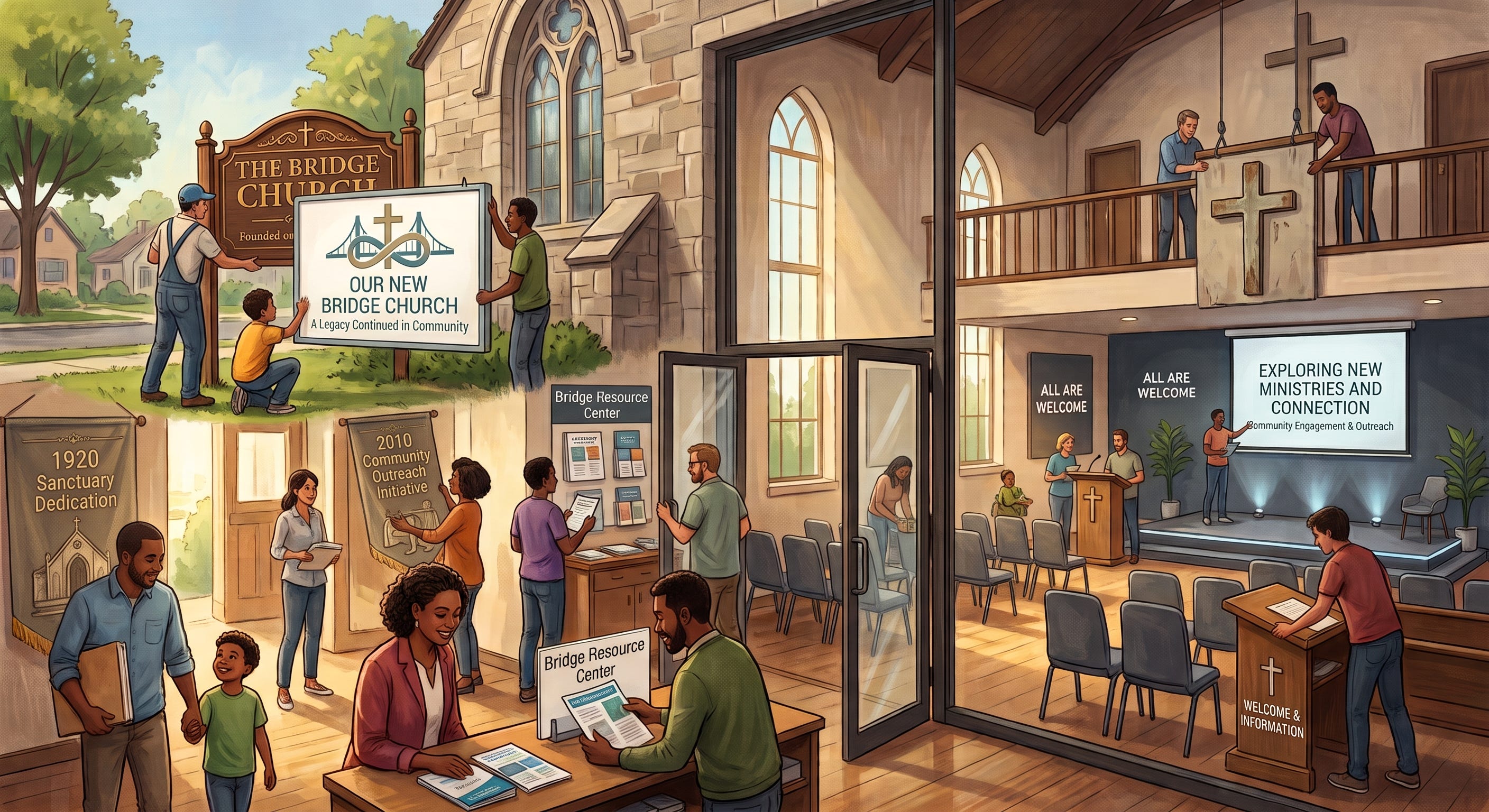
Typically, congregations do not shift from denominationally affiliated to non-denominational overnight. They go through phases that take years or even decades. This is partially why the first half-century—1975-2025—of the transition of denominational Protestantism to non-denominational focused on new congregations launched by entrepreneurial leadership.
I believe the next fifty years will focus on denominational congregations following the lead of those who have come before them, sharing what they have found within the non-denominational movement.
Cross Carrying & Hope Sharing
Is there anything to be said about the Great Commission that hasn’t already been said? Pastors and thinkers, theologians and writers, podcasters and bloggers alike have spilled ink and shared opinions to the point where it often feels like the Great Commission has been discussed more than it has been practiced.
In all our church discussions surrounding the Great Commission, have we somehow talked ourselves out of doing it?
From what I have observed over more than four decades the Episcopal Church excels at dissuading itself that it needs to evangelize the unchurched and spiritually disconnected and to make more disciples as our Lord commanded, not suggested, not encouraged, but COMMANDED!Your Church Needs This More Than a New Coffee Bar
Kimberli Lira wrote this after cancer took her husband. It asks the question most church growth plans skip: who is actually sitting in your seats on Sunday, and what do they need?
Before Your Church Plants, Ask Why
Healthy churches multiply. The reason God saved us is the same reason we plant churches. It’s all for the glory of God.
Also See: Before Your Church Plants, Ask HowWinning the Gap: Why the Next Phase of a Proven Multisite Strategy May Begin Portably
The strategic question: When the next location is part of the plan, why wait years for a permanent facility before beginning ministry in the community?
All of the church plants in which I was involved from the mid-1980s on, two Episcopal, one United Methodist, and two Southern Baptist began portably, in a tennis clubhouse, a living room, a maritime museum conference room, a firestation, and a student union banquet room.Christian leaders issue ‘sober and urgent call’ for Western Church to prepare for disruption
Christian leaders Steve and Esther Uppal have issued what they described as a “sober, urgent call” to Christians and church leaders in the West, warning that they believe a period of major disruption may be approaching.
Speaking in a video published by Revival Times on September 4, the couple said they had sensed throughout 2026 that the Church should prepare spiritually for “great change and challenge”.
Pope Leo says existential concerns about AI 'should be taken seriously'
'If someone were to ask me, am I in panic mode? No, I sleep at night,' the pope said. But, he doesn’t believe the warnings regarding AI are 'fake news, as some have said.'
Clergy Age Trends in the United Methodist Church: 1985-2026
Notice in the chart below the change between 2000 and 2015 when the percentage of elders between 35 and 54 dropped from 65 percent in 2000 to 38 percent in 2015, with the percentage of elders between 55 and 72 increasing from 30 percent in 2000 to 55 percent in 2015. This major adjustment in the elder makeup reflected the aging of the historically large baby boom generation. In 2000, the youngest boomer was 36, and the oldest was 54. By 2015, the youngest boomer was 51, and the oldest was 69. By 2026, there is a rebalancing of the middle and older age cohorts. In 2026, elders between 35 and 54 are relatively close to that age group’s presence in the total population between 25 and 72. Older elders are still disproportionately represented compared to the same general population pool. Young elders below the age of 35 continue to be represented well below the presence of their age group among the general population ages 25 to 72.
JRR Tolkien to join CS Lewis in Westminster Abbey’s Poets’ Corner
J.R.R. Tolkien, the devout Catholic author whose Christian beliefs helped shape The Hobbit and The Lord of the Rings, will be honored with a memorial in Poets’ Corner at London’s Westminster Abbey, alongside his close friend and fellow Christian writer C.S. Lewis.
Westminster Abbey announced that the memorial to the author, scholar, linguist and artist is scheduled to be unveiled during a dedication ceremony in spring 2027, coinciding with the 90th anniversary of The Hobbit and the 50th anniversary of The Silmarillion.
Preach Sermons, Not Commentaries
Sermontaries inform, sermons transform. Greg Morse explains the difference.
A surprising number of Americans use AI for spiritual reasons. Here's what they told us
The poll found that 11% of AI users have sought spiritual guidance from artificial intelligence, while 13% have used the technology to generate prayers, and 15% say they have used it to study Scripture.
A Crisis in Formation: How AI Is Shaping Teenagers and Their Spiritual Lives
For many students, AI is deeply woven into the rhythms of ordinary life. Teenagers are using tools like OpenAI ChatGPT, Microsoft Copilot, Google Gemini, and other AI systems to write essays, summarize readings, generate study guides, brainstorm captions, process emotions, and even ask spiritual questions they hesitate to bring to parents, pastors, or mentors. AI increasingly functions as a tutor, assistant, pastor, parent, editor, counselor, and companion all at once.
Students are not merely active users of AI; they are also passively shaped by it. Large language models are now embedded throughout the digital ecosystems teenagers inhabit—often in ways they barely recognize. AI is no longer confined to academics or productivity. It is influencing social media feeds, entertainment, gaming, advertising, online shopping, and countless other spaces that shape young people’s desires, imaginations, habits, and identities.
The Church cannot afford to view AI as merely another technological development. We must think about it theologically, pastorally, and formationally. The central question is not simply whether AI is “good” or “bad,” but what kind of people these technologies shape us to become. We are all discipled one way or another; the real question is whether we can recognize who or what is discipling us.
The Hidden Apologetic of Humility
A Christian apologist should be confident in the doctrines of the faith, but confidence in Christianity doesn’t negate the need for humility.
Image Credit: George Bullard's Journal: Pursuing A Christlike Reflex

No comments:
Post a Comment